How to Evaluate AI Fashion Photography: A Seven-Point Technical Standard
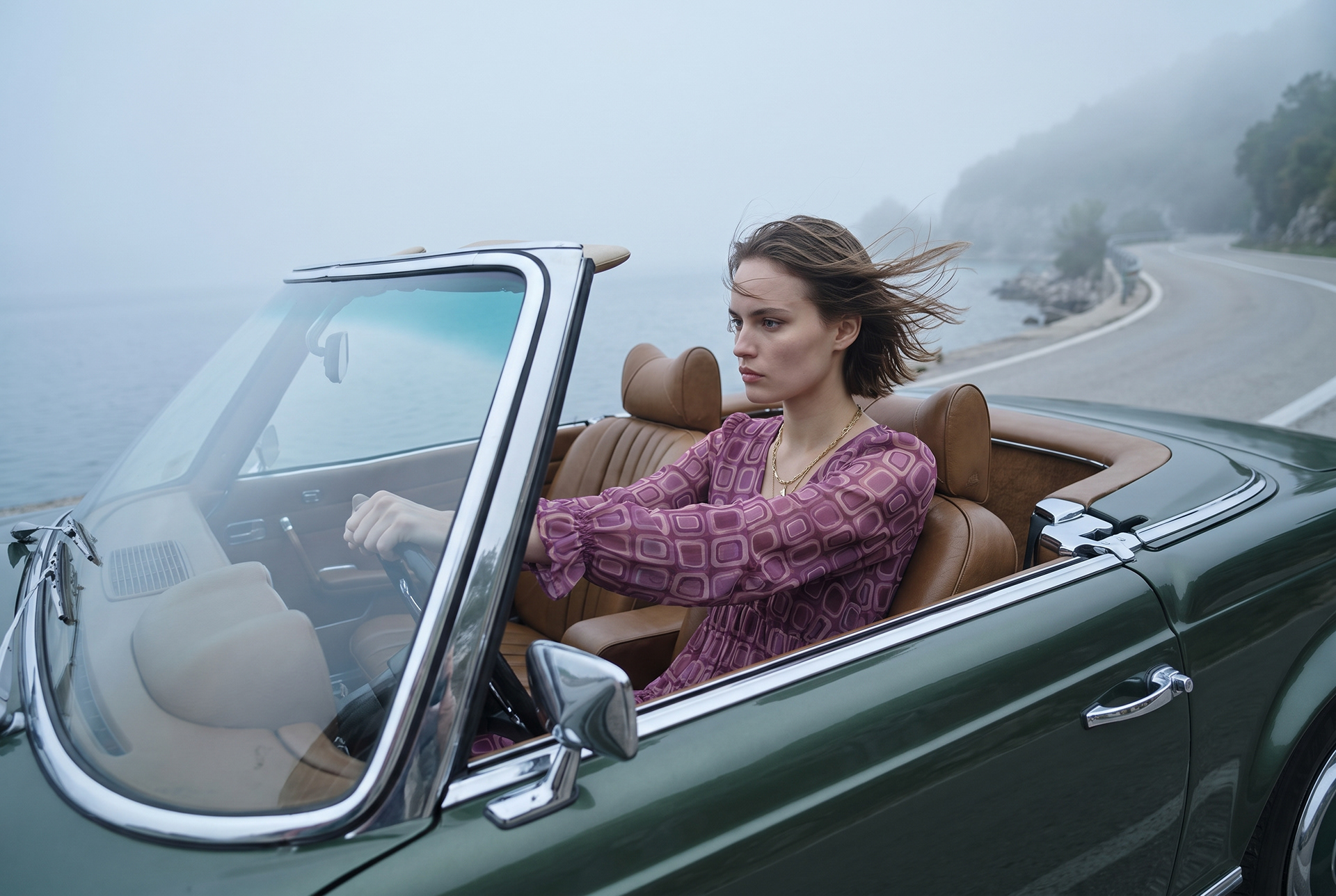
Most of the discussion around AI in fashion imagery is still stuck on the wrong question. People ask whether the image looks real.
That was the right question in 2023. It isn't anymore. Frontier models now produce skin, hair, and light that survive professional inspection without much effort. Realism is effectively solved. It is no longer the constraint.
The question that actually determines whether a generated image can go on a product page or into a campaign is different:
Is the garment in the output still the garment that went in?
Garment fidelity is the degree to which a generated image preserves the physical and constructional properties of the real product: silhouette, drape, seam structure, print registration, material behaviour under light, hardware, and proportion. It is the single metric that separates a demo from a production asset, and almost nobody in the market is measuring it.
Below is the protocol I use. It works on any platform, any model, any vendor. You can run it in about ninety seconds per image, and it does not require you to know anything about how the image was made.
1. Silhouette and drape
Does the garment fall the way its weight and cut require it to fall?
A crepe dress and a neoprene dress can share the same pattern and behave completely differently on a body. Generative models default to a generic clothing prior: a statistical average of how "fabric" hangs, which produces drape that is plausible but not specific.
What to check: the hem, and where the fabric breaks at the waist, hip, and knee. Heavy fabrics should hold volume and fall in few, wide folds. Light fabrics should collapse and gather. If everything in the image drapes at the same medium weight, you are looking at an average, not your product.
2. Seam and panel continuity
Construction lines are where generation breaks first.
Princess seams, darts, yokes, panel joins, topstitching. These carry the identity of the garment, and they are exactly the kind of thin, semantically meaningless detail that diffusion models discard. A seam that begins at the shoulder and dissolves before the waist is the most common failure in AI fashion imagery, and the one that non-technical reviewers almost never catch.
What to check: follow every construction line from one end to the other. It must terminate where it should terminate, and meet its counterpart across the body.
3. Print registration and repeat scale
A print is not a texture. It has a repeat size relative to the body, a direction, and a behaviour at seams.
What to check: stripes must follow the grain, meet at the side seam, and change direction at a dart. A check must maintain its scale from shoulder to hem. A placed print must sit where the tech pack says it sits. Generated prints tend to drift in scale across the body, break at seams, and lose directionality on sleeves. For anything patterned, this is the primary failure mode and the one with the highest commercial cost, because the customer receiving the box will see the difference immediately.
4. Material response to light
Fabric is defined optically far more than chromatically. You do not recognise silk by its colour. You recognise it by how it returns light.
Silk has a directional sheen that runs along the warp. Wool crepe diffuses almost completely and has no specular component. Leather produces a hard specular hit with a fast falloff. Technical synthetics reflect flat and slightly plastic. Denim has a low, broad sheen broken by the twill.
What to check: if every material in the frame reflects light the same way, the model has rendered your fabric as colour rather than substance. This is the failure most invisible to non-photographers and most obvious to buyers
5. Hardware, trim, and placement
Zips, buttons, buckles, eyelets, stitching colour, label position, logo geometry.
These details are small, high-frequency, and semantically fragile, which makes them the region where models hallucinate most. They are also, legally and commercially, part of the product's identity. A generated zip pull that is not your zip pull is a misrepresentation of the item you are selling.
What to check: count them. Compare shape against the real product. Verify placement in absolute terms, not by impression.
6. Fit and proportion
Where does the sleeve break on the wrist? Where does the shoulder seam sit relative to the actual shoulder point? What is the rise, the hem length, the ease through the body?
Generative systems tend to fit the garment to the model. Real photography shows how the model fills the garment. That inversion is subtle, and it is the difference between an image that reads as a fitting and an image that reads as fashion.
What to check: compare the four break points: shoulder, wrist, waist, he, against the size chart, not against your aesthetic impression.
7. Cross-image consistency
A single good image proves nothing. Production is a set.
This check runs at two levels, and most evaluations skip the first one.
Level one: the cross-view gate, on a single SKU. Before you approve any garment, generate it from at least three angles: front, three-quarter, and back. Then compare button count, placket alignment, seam positions, and print placement across all three.
Approving a hero frame is not approving the SKU. A shopper swipes through four images on a product page, and single-image fidelity can conceal a variant that falls apart on the second swipe. Back views break most often — there are fewer landmarks for the model to anchor to, and rear views are the least represented angle in most training data. Placket drift is the sharpest tell: a placket that moves half a centimetre between views reads as a different garment, and the reviewer usually cannot say why.
Level two: the set, across scenes. Produce the same garment across a series of images and compare them as a group, deliberately changing the scene each time. Different location, different light direction, different colour temperature, different pose. What must not move is the garment and the identity wearing it: same print scale, same construction, same fit, same face, same proportions.
Holding a garment stable while the light stays fixed is not a test. Holding it stable while the light changes is the actual production requirement, because a collection is shot across studio, location, and campaign contexts — and that is where most systems fail.
One practical note on how to run it: do not compare each frame against the one before it. Drift is gradual, so every image looks acceptable next to its neighbour. Compare the last frame against the first, then work backwards to find where it started to move.
Why these failures happen
They are structural, not incidental.
A diffusion model is trained to generate an image that is plausible, not one that is identical. Left to its own prior, it will always regress toward the statistical centre of its training data: average drape, average sheen, generic hardware, decorative rather than functional seams. Prompting cannot fix this, because language is a very low-bandwidth channel for physical specification. You cannot write the weight of a fabric.
What does fix it is conditioning: constraining the generation with information the model is not allowed to invent:
- Garment segmentation and masking, which isolates product pixels and protects them during inpainting, so the generation happens around the garment rather than through it.
- Structural conditioning on depth and edge maps derived from the original product photo, which preserves silhouette and construction independently of the model's aesthetic prior.
- Seed and latent-space anchoring, which keeps light, contrast, and colour temperature mathematically stable across an entire set instead of re-rolling them on every generation.
These three constraints are the reason I ended up building my own pipeline instead of adapting a generic one. When I started producing AI campaigns for clients in 2023, every tool I tested optimised for the aesthetic of the output and treated the garment as one more thing to be invented. For a photographer that is the wrong default: on a real set, the product is the only element that is not negotiable. FluidVision was built around that inversion: the garment is fixed, everything else is a variable.
This is why the interesting engineering in AI fashion imagery is not happening at the model layer. Every serious platform is calling the same three or four frontier models. The differentiation is entirely in what you constrain, what you preserve, and what you let the model decide.
What this changes for production teams
Use the seven checks as a purchasing criterion, not just a quality check.
When you evaluate any AI imaging vendor, do not send them a hero product with a clean silhouette and a solid colour. Send them your hardest SKU: a striped shirt with a placed logo, a technical jacket with visible hardware, a bias-cut silk dress. Then ask for forty variations, not four.
Anything can produce one good image. The seven-point test is designed to find out whether it can produce the fortieth.
Revision note, August 2026: check seven has been expanded into two levels following a discussion with Ruchika Shaw, who proposed a cross-view gate on a single SKU as a precondition to set-level consistency. It is a better formulation than the one I was using informally, and it corrects a real gap in the original version: consistency was written as a set-level test when it should be SKU-level first. This protocol is intended to be revised as the failure modes change.
Luca Patrone is a fashion photographer and film director with 25 years of production experience for brands including Bugatti, Hublot, Zuhair Murad, Elie Saab, and Virgin Active. Since 2023 he has worked exclusively on hybrid and AI-generated campaign production, and is the founder of FluidVision.ai, the AI fashion photography studio where this evaluation protocol was developed and tested across live client collections.